




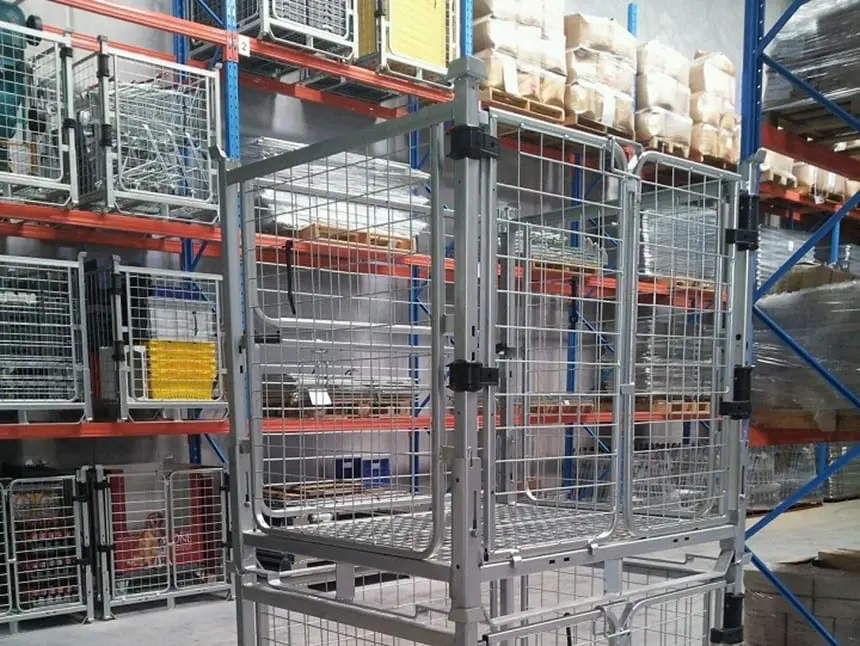
Foldable cages are innovative material handling solutions that collapse to a fraction of their original size when empty, dramatically reducing warehouse storage costs through space optimisation and improved logistics efficiency. These versatile storage systems address common warehouse challenges by minimising storage requirements, reducing transportation costs, and maximising warehouse utilisation rates across retail, logistics, and manufacturing industries.
Understanding foldable cages in modern warehouse operations
Foldable cages represent a revolutionary approach to warehouse storage challenges, offering material handling solutions that adapt to varying operational demands. These innovative systems serve as the backbone of modern intralogistics, providing flexible storage options that can be expanded when needed and collapsed when not in use.
In today’s competitive warehouse environment, space efficiency directly impacts operational costs. Traditional rigid storage solutions occupy valuable floor space regardless of whether they’re actively storing goods. Foldable cages eliminate this inefficiency by collapsing to approximately 20% of their expanded size when empty.
The retail, logistics, and manufacturing sectors particularly benefit from these solutions due to their fluctuating storage requirements. Seasonal demand variations, batch processing, and just-in-time delivery schedules create constant changes in storage needs that foldable systems accommodate seamlessly.
What are foldable cages and how do they work?
Foldable cages are collapsible storage containers constructed from durable materials like steel or reinforced plastic, featuring hinged panels and locking mechanisms that allow them to fold flat when empty. The folding mechanism typically involves side panels that fold inward and a base that can be compressed or stacked.
The construction utilises robust hinges and spring-loaded latches that ensure quick deployment and secure folding. Most systems employ a simple push-and-pull mechanism that requires minimal training for warehouse staff. The materials used are specifically chosen for their strength-to-weight ratio, ensuring durability whilst maintaining ease of handling.
These cages operate on straightforward principles: when needed, they unfold into rigid storage containers capable of holding substantial loads. When storage requirements decrease, they fold flat for compact storage or efficient return transportation. The locking mechanisms ensure structural integrity during use whilst allowing effortless collapse when required.
How do foldable cages reduce warehouse storage costs?
The primary cost reduction mechanism stems from space optimisation when cages are empty. Traditional storage solutions occupy the same floor space whether full or empty, whilst foldable alternatives reduce their footprint by up to 80% when collapsed.
Transportation costs decrease significantly because more empty units can be shipped in a single load. This efficiency extends to return logistics, where collapsed cages require minimal transport space compared to rigid alternatives. The reduced volume translates directly into lower shipping costs and improved vehicle utilisation.
Storage requirements in the warehouse itself become more manageable. Empty foldable cages can be stored in compact stacks, freeing valuable floor space for active operations. This improved space utilisation often eliminates the need for additional storage areas or warehouse expansion.
Warehouse utilisation rates improve as operational flexibility increases. The ability to quickly deploy or store cages based on demand fluctuations maximises the effective use of available space throughout different operational periods.
What are the key benefits of using foldable cages over traditional storage solutions?
Space efficiency represents the most significant advantage, with foldable cages offering superior flexibility compared to rigid storage systems. This adaptability allows warehouses to respond quickly to changing storage requirements without permanent infrastructure modifications.
Labour savings occur through simplified handling procedures. The lightweight design when empty reduces manual handling strain, whilst the quick deployment mechanism minimises setup time. Staff can easily manage larger quantities of storage units with less physical effort.
Versatility across different industries makes these solutions particularly valuable. Whether storing automotive parts, retail merchandise, or food products, foldable cages adapt to various load types and warehouse configurations.
| Feature | Foldable Cages | Traditional Storage |
|---|---|---|
| Space when empty | 20% of full size | 100% of full size |
| Setup time | Under 30 seconds | Not applicable |
| Transport efficiency | 5x more units per load | Standard capacity |
| Flexibility | High adaptability | Fixed configuration |
Integration with existing warehouse systems occurs seamlessly, as most foldable cages are designed to work with standard material handling equipment and warehouse management systems.
How do you choose the right foldable cage system for your warehouse?
Capacity requirements form the foundation of selection criteria. Assess your typical load weights, dimensions, and stacking requirements to determine the appropriate structural specifications for your operations.
Size specifications must align with your warehouse layout, including aisle widths, ceiling heights, and equipment compatibility. Consider both the expanded and collapsed dimensions to ensure proper fit throughout your facility.
Material considerations depend on your specific applications. Steel construction offers maximum durability for heavy-duty applications, whilst reinforced plastic provides corrosion resistance for food or pharmaceutical environments.
Industry-specific needs influence design requirements. Food manufacturing may require easy-clean surfaces, whilst automotive applications might need specialised load configurations. Evaluate these requirements against available options.
Compatibility with existing logistics operations ensures smooth integration. Verify that chosen systems work with your current material handling equipment, storage procedures, and warehouse management systems.
Maximising warehouse efficiency with foldable cage solutions
Implementing foldable cages for cost reduction requires strategic planning that considers both immediate space savings and long-term operational benefits. The return on investment typically becomes apparent within months through reduced storage costs and improved operational efficiency.
Space optimisation extends beyond simple storage reduction. The flexibility to rapidly reconfigure storage layouts enables dynamic warehouse management that adapts to seasonal demands, promotional activities, and changing product lines.
Long-term operational benefits include reduced facility expansion needs, lower transportation costs, and improved workforce productivity. The cumulative effect of these improvements often exceeds initial cost savings projections.
ROI considerations should encompass both direct cost savings and indirect benefits such as improved customer service through faster order fulfilment and reduced handling errors. The flexibility inherent in foldable systems often enables operational improvements that extend far beyond simple cost reduction.
Ready to transform your warehouse operations with foldable cage solutions? Discover our comprehensive range of material handling equipment designed to optimise your storage efficiency and reduce operational costs. From foldable cages to complete intralogistics systems, we offer solutions tailored to your specific warehouse requirements.
Take the next step towards warehouse efficiency optimisation. Contact our experts today to discuss how foldable cage solutions can be customised for your operations and to receive a detailed assessment of potential cost savings for your facility.